Benefits of Using the Business Model Canvas System

Turn your business idea into a clear, testable plan—one customer, one offer, and one decision at a time.
Starting or growing a small business requires more than enthusiasm. You need to understand the people you want to serve, the problem you solve, the way customers find you, the work required to deliver your promise, and the money needed to keep everything operating. These questions can become overwhelming when they live in separate notebooks, spreadsheets, and conversations. The Business Model Canvas brings them together in a single visual framework.
For members of 1Knowledge Online, this approach is especially practical. A Business member may be building a branded Business Space, showcasing professional services, posting Marketplace listings, connecting through groups, or organizing a project. The Canvas helps connect those activities to a clear purpose. Instead of asking only, “Which tools should I use?” you can ask, “Which tools support the customers, value proposition, and operating model I am trying to build?”
The Canvas is useful whether you are a chef exploring a catering service, a designer selling creative work, a contractor organizing renovation projects, a coach packaging expertise, or an entrepreneur testing a product. You do not have to know every answer before beginning. You need an honest first draft and a willingness to replace assumptions with evidence.
 What Is the Business Model Canvas?
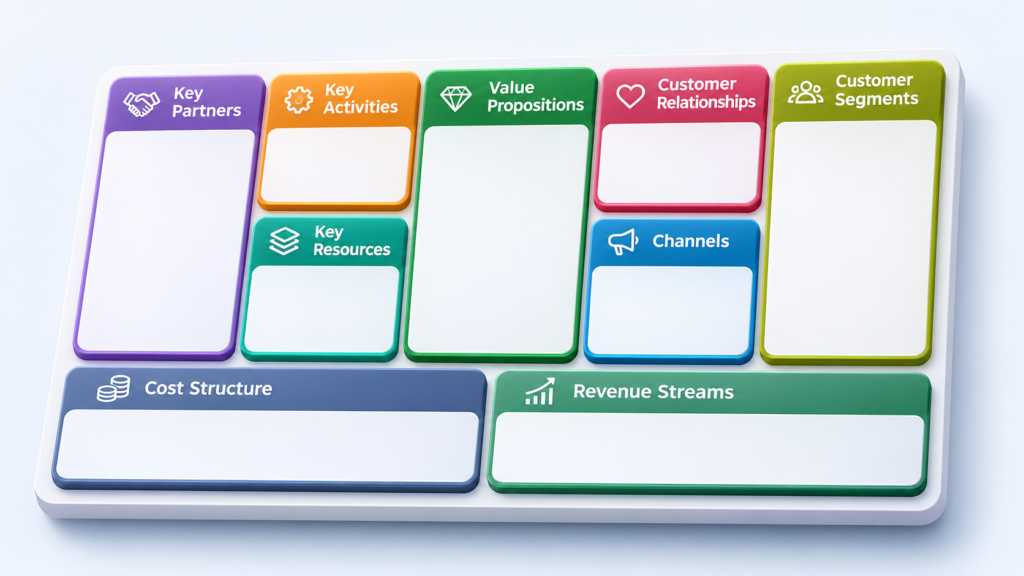
The Business Model Canvas, developed by Alexander Osterwalder and Yves Pigneur and popularized through Business Model Generation, is a one-page tool organized into nine interconnected building blocks. Each block answers a different business question. Together, they describe how an enterprise intends to create value for customers, deliver that value, and earn enough income to sustain its activities.
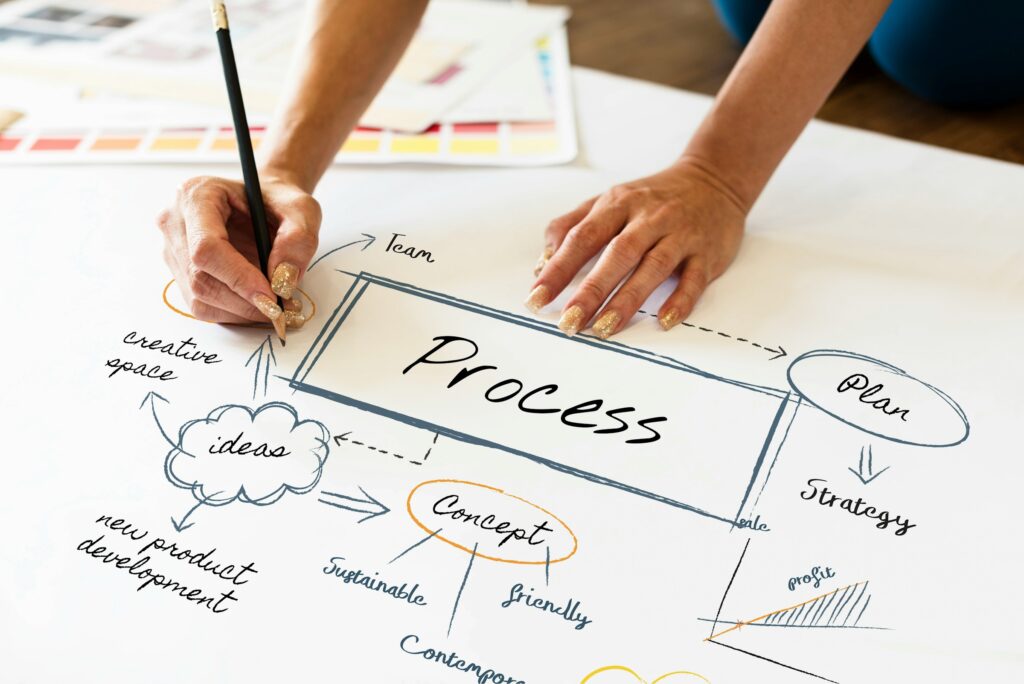
A traditional business plan may include dozens of pages of research, financial projections, operational procedures, and background. Those details still matter, especially when applying for financing, entering regulated fields, or managing a complex venture. The Canvas serves a different purpose. It makes the central logic of the business visible so that you can discuss it, challenge it, and revise it without rewriting an entire plan.
Imagine placing nine labeled boxes on a wall and writing a few short ideas in each. You might discover that you know exactly what you want to sell but have not identified who will buy it. You may understand your customers but have no reliable delivery process. Or you may find that your price sounds attractive until you calculate the true costs. Those gaps are valuable discoveries: they show where to focus your research before committing additional time or money.
The key principle is simple: your first Canvas is a set of working assumptions, not proof that a business will succeed. Review it whenever actual conversations, transactions, expenses, or market conditions teach you something new.
 Seven Major Benefits for Entrepreneurs and Small Businesses
1. Clarity: See the Whole Business at Once
Business owners often become absorbed in one area—creating a logo, designing a product, buying equipment, or posting on social media—while overlooking other essential pieces. The Canvas puts the full business model in view. It encourages a balanced conversation about customers, offers, resources, operations, and finances. A single-page overview can make decisions faster because it reminds you how one choice affects several others.
2. Focus: Spend Time on What Matters Most
Every business has limited attention and resources. A Canvas helps distinguish work that directly supports the business model from activities that merely feel productive. If your biggest uncertainty is whether customers will pay for a service, gathering customer feedback may be more valuable than purchasing more software. If demand already exists but delivery is unreliable, improving your process could matter more than advertising.
3. Better Customer Understanding
The Canvas begins with specific customer groups instead of an imaginary audience of “everyone.” It encourages you to learn what people are trying to accomplish, what frustrates them, and what they value. This knowledge leads to clearer offers, more relevant messages, and more useful customer conversations. It also helps prevent the common mistake of building something that interests the owner but does not solve an important customer problem.
4. Smarter Financial Decisions
Revenue and costs have their own blocks because attention and enthusiasm cannot substitute for workable economics. The Canvas encourages you to identify how money enters the business and what it costs to deliver the product or service. You can compare different price points, estimate contribution per sale, and consider how much volume you would need to cover recurring expenses. These calculations will not guarantee profit, but they can reveal weaknesses early.
5. Easier Collaboration and Communication
A shared Canvas gives founders, freelancers, mentors, and collaborators a common reference point. Rather than exchanging vague descriptions of the business, you can discuss a particular section. A potential partner may identify a better distribution channel; a contractor may uncover an operational bottleneck; a customer may challenge the promised value. This structure can make meetings and project discussions more useful.
6. Flexibility Without Losing Direction
Customer preferences, supplier prices, and competitors change. A Canvas is designed to be revised. When an assumption proves wrong, you can adjust the affected block and examine the consequences elsewhere. For example, switching from local customers to nationwide clients may change delivery methods, customer support, marketing channels, pricing, and costs. The Canvas helps make those dependencies visible.
7. More Intentional Use of 1Knowledge Tools
For 1Knowledge Business members, the Canvas can act as a guide to choosing platform features. A Business Space may support brand presentation. A Professional Services listing may support an offer and a customer-discovery channel. Groups, forums, and video meetings may support relationships and feedback. A project manager may support delivery. Marketplace listings may help buyers discover physical items. Each feature works best when attached to a defined objective and a way to evaluate results.
 The Nine Building Blocks: How to Build Your Canvas
The nine sections should be considered together. A convenient starting order is: Customer Segments, Value Propositions, Channels, Customer Relationships, Revenue Streams, Key Resources, Key Activities, Key Partnerships, and Cost Structure. This is a learning sequence, not a rule that every entrepreneur must follow.
Block 1: Customer Segments — Who Are You Really Serving?
Customers are not simply a crowd you hope will notice your business. They are groups of people or organizations with identifiable needs, priorities, and buying behaviors. A customer segment should be specific enough that you can imagine speaking directly to its members. “Anyone who needs help” is usually too broad. “Busy local homeowners who need small weekend repair jobs completed” is a more useful starting point.
Consider a freelance photographer. Their possible segments might include graduates, families, small restaurants, or real estate professionals. Each group wants different outcomes, uses different language, and may have a different budget. A graduation client may value affordable packages and convenient scheduling. A restaurant may need consistent images for menus and promotions. Trying to advertise one generic service to both groups can weaken the message.
Begin with one primary segment. Ask where these people live or work, what problem they encounter, how often it occurs, what they currently use instead, and what would make them trust a new provider. Interview potential customers without turning every conversation into a sales pitch. Listen for repeated descriptions of frustration, urgency, and desired results.
On 1Knowledge, a Business member can explore discussions, review questions raised in forums, and engage respectfully with Community members who may become customers. The goal is not to send unsolicited promotions. It is to learn the audience’s concerns and build a more relevant offer.
Canvas prompt: “Our first priority customers are ______ because they need ______ and currently struggle with ______.”
Block 2: Value Propositions — Why Would Customers Choose You?
Your value proposition describes the meaningful benefit a particular customer receives from your product or service. It is more than a catchy slogan or a list of features. It answers a practical question: What problem do you solve, or what desirable outcome do you help customers achieve?
Suppose you operate a home-organizing service. “We organize closets” describes an activity. “We help busy households find what they need and maintain clutter-free storage without spending an entire weekend sorting” communicates a customer result. A strong value proposition links a clear audience, a real problem, and a credible outcome.
Value can come from saving time, improving convenience, reducing risk, offering customization, increasing accessibility, enhancing quality, or creating a memorable experience. You do not need to claim that your business is the best, fastest, or cheapest. Make claims you can support. If the service is new, present your proposed benefit as a promise you are working to validate rather than a proven performance result.
Write two or three possible value propositions and test them with prospective buyers. Ask which one feels relevant and why. Pay close attention to questions about price, timing, quality, and reliability. Those questions often reveal the criteria customers use to make decisions.
Your 1Knowledge Business Space and service listings can communicate the chosen proposition through clear descriptions, sample work, FAQs, and contact information. The goal is to show visitors why the offer matters before asking them to take action.
Canvas prompt: “We help ______ achieve ______ through ______, with a particular emphasis on ______.”
Block 3: Channels — How Will People Discover, Evaluate, and Receive Your Offer?
Channels are the ways your business connects with customers throughout the buying journey. They include awareness, evaluation, purchase, delivery, and after-sale communication. A social post may create awareness, but it does not automatically provide a way to ask questions, compare options, arrange payment, or receive the item. An effective channel strategy considers the entire path.
For a local baker, discovery might happen through a neighborhood recommendation or an online photo. Evaluation may involve a menu, allergy information, and examples of previous orders. Ordering could happen through a direct conversation. Delivery may involve pickup at an agreed location. Follow-up could include a message requesting feedback after the event. Each step should be understandable to the customer.
A 1Knowledge Business member can use a Business Space as a branded introduction, a Professional Services listing to make a service easier to find, or Marketplace listings to describe items for sale. The 1Knowledge Marketplace does not process payments on the website: buyers and sellers message one another and arrange their transactions and exchanges directly. Members should clearly communicate terms and use appropriate safety practices for any in-person meeting.
Do not assume that being listed automatically creates customer demand. Share accurate links where permitted, experiment with useful educational content, observe which inquiries occur, and improve the next step for interested visitors. A smaller number of well-managed channels is often better than a large collection of neglected profiles.
Canvas prompt: “People first discover us through ______, evaluate us through ______, contact us through ______, and receive the offer through ______.”
Block 4: Customer Relationships — How Will You Earn Trust and Encourage Repeat Business?
Finding a customer is only the beginning. Your business also needs a way to answer questions, set expectations, handle concerns, and remain useful after a sale. The appropriate relationship depends on the business. A renovation client may expect detailed consultations and progress updates. Someone purchasing a small handmade item may mainly want accurate photos, a quick response, and a dependable exchange.
Customer relationships can include one-to-one assistance, appointment-based consultations, email updates, community engagement, onboarding instructions, and post-purchase support. The purpose is not to overwhelm customers with constant messages. It is to create a reliable experience that matches their needs and preferences.
Think about the questions customers repeatedly ask. Could better photos, clear descriptions, stated availability, or a simple explanation of your process answer those questions sooner? What should happen if an appointment is delayed, an order changes, or the result does not match expectations? A written service policy, respectful communication, and timely follow-up can reduce confusion.
On 1Knowledge, members can participate in groups and forums, connect through profiles, and use video meetings where appropriate. These tools can support consultations, demonstrations, or community conversations. If you plan a live product showcase or a service Q&A, announce its purpose clearly, obtain any necessary permissions, and provide a simple way for interested participants to follow up.
Trust is developed through consistent behavior, not through membership status alone. Keep commitments realistic, explain limitations, and avoid implying that platform participation verifies the quality of your business.
Canvas prompt: “Customers should expect ______ before purchase, ______ during delivery, and ______ afterward.”
Block 5: Revenue Streams — How Does the Business Earn Money?
Revenue streams describe the ways customers pay for value. A consultant may charge per hour or by project. A craft seller may earn income from individual product sales. A teacher may offer workshops or recurring classes. One business may have several streams, but each should connect to a real customer need and a clearly defined offer.
Imagine a graphic designer who sells custom logos for a fixed project fee, offers monthly design support to returning clients, and teaches a paid beginner workshop. These are three different revenue streams. Each has its own pricing logic, workload, customer expectations, and delivery requirements. Diversification can create opportunities, but too many offers at the beginning can spread an owner thin.
Do a basic calculation. If a product sells for $50 and the materials, packaging, and direct transaction expenses total $20, the remaining $30 is a contribution toward labor, overhead, taxes, and profit—not automatically take-home earnings. A service owner should also account for preparation, customer communication, revisions, and unpaid administrative work when evaluating prices.
When using 1Knowledge, distinguish between discovering a customer and collecting payment. Marketplace buyers and sellers complete payment arrangements outside the site. For Professional Services, agree on scope, payment terms, and delivery responsibilities with each client. A peer-to-peer fundraising campaign, when appropriate and permitted, is a funding method; it should not automatically be classified as customer sales revenue. The accounting and tax treatment depends on the facts.
Create a simple record of inquiries, accepted offers, sales, refunds, and expenses. As actual data accumulates, replace price guesses with observations.
Canvas prompt: “Customers pay us ______ for ______. Our price is ______, and our estimated direct cost per sale is ______.”
Block 6: Key Resources — What Must You Have to Deliver the Promise?
Key resources are the assets your business truly needs. Some are physical, such as equipment, inventory, workspace, or transportation. Others are human, including skills, time, and trusted collaborators. Intellectual resources may include original designs, a recognizable brand, procedures, licenses, or specialized knowledge. Financial resources include the cash required to buy materials and cover obligations before payment arrives.
A mobile food business might need approved food preparation facilities, trained workers, reliable suppliers, safe transportation, and any licenses or permits required locally. A virtual assistant may need a dependable computer, a secure internet connection, scheduling skills, and clear client workflows. The resources differ, even when both businesses serve small-business customers.
The Canvas helps separate essential resources from attractive extras. Owning expensive equipment may not make sense before demand is established. Could you rent, borrow, or work with a partner during a pilot? Could you begin with one service package instead of purchasing resources for five different offers? Every commitment should connect to a customer need or a delivery requirement.
For 1Knowledge Business members, a completed profile, Business Space, sample portfolio, project information, and accessible communication tools may support the visibility and coordination side of the model. However, the platform does not replace professional qualifications, licenses, insurance, accounting systems, or the equipment needed to perform the actual work.
Canvas prompt: “To serve our first customers reliably, we must have ______, ______, and ______. We can postpone ______ until demand is verified.”
Block 7: Key Activities — What Work Creates the Customer Result?
Key activities are the essential actions that make the business operate. They may include producing goods, performing professional services, marketing, scheduling, customer support, quality control, order fulfillment, bookkeeping, and improving processes. Your Canvas should emphasize the activities most important to your value proposition instead of listing every possible task.
Consider a residential painting business. Its most important activities may include assessing jobs, preparing accurate estimates, protecting the work area, completing quality painting, communicating timelines, and correcting defects. Posting online has value only if the business can fulfill the promises that attract customers. A skilled service provider who accepts more work than the team can deliver risks damaging trust.
Choose a small number of recurring processes and document them. What happens when a customer inquires? Who prepares an estimate? How is an appointment confirmed? How do you track materials, deadlines, approvals, and completion? Even a solo entrepreneur benefits from repeatable steps because a clear process reduces missed details.
1Knowledge’s project-management tools can be used to organize tasks, timelines, and collaboration where available to the member. Video meetings may support planning or client conversations. A Business Space can communicate the final offer, while Marketplace or Professional Services listings can support promotion. The Canvas helps you connect each operational activity to the value customers expect.
Set a simple weekly rhythm: review incoming requests, active projects, promised delivery dates, and cash obligations. When an activity repeatedly creates delays, redesign the process before increasing demand.
Canvas prompt: “The three activities that most directly create our customer’s result are ______, ______, and ______.”
Block 8: Key Partnerships — Who Can Help You Deliver More Reliably?
Few businesses operate entirely alone. Key partnerships may involve suppliers, subcontractors, referral partners, distribution providers, professional advisers, venue operators, or complementary businesses. The right partner can help you fill a skill gap, reach an audience, maintain capacity, or obtain needed materials without building everything yourself.
A wedding photographer might collaborate with event planners, florists, makeup artists, and venue operators. A small home-renovation firm may require dependable specialists for particular trades. A handmade jewelry business may need packaging suppliers, local event organizers, and reliable material vendors. The purpose is to identify relationships that support delivery and customer value—not simply collect names in a contact list.
Before agreeing to work together, discuss responsibilities, quality expectations, timelines, costs, client communication, payment, intellectual-property ownership when relevant, and what happens if plans change. For regulated work, verify the credentials, insurance, or permits that apply. A friendly introduction is not a substitute for appropriate due diligence.
Within 1Knowledge, members can discover businesses, engage in groups, participate in discussions, and explore professional service listings. These connections may lead to productive collaborations, but each business owner should independently assess the suitability of a potential partner. Start with a small, well-defined project before depending on a new collaborator for a critical part of your operation.
Canvas prompt: “Our most important partners are ______ because they help us obtain ______ or perform ______.”
Block 9: Cost Structure — What Does It Take to Keep the Business Running?
Cost Structure brings the business model back to reality. Even when the idea is attractive and customers show interest, a business needs enough income and cash to cover its obligations. Identify both fixed costs, which generally recur regardless of individual sales, and variable costs, which rise as sales or work increase.
Fixed costs may include membership fees, insurance, certain software subscriptions, workspace rent, and recurring professional services. Variable costs may include ingredients, raw materials, packaging, transaction charges, shipping, commissions, and some subcontractor expenses. Your own labor is easy to overlook, but it must be considered when testing whether an offer is worth delivering.
For an example, imagine a service package priced at $150, with $45 in directly attributable costs. Its estimated contribution is $105 before fixed costs, owner compensation not already included, taxes, and other obligations. If monthly fixed costs total $420, the business would need four such packages to cover that fixed-cost amount assuming the direct-cost estimate and sales mix remain unchanged. That does not yet establish an adequate owner salary or a sustainable business.
If you subscribe to 1Knowledge Business membership, its advertised $12.95 monthly price belongs in your cost plan alongside your other actual expenses. Treat the membership as a possible resource for visibility and organization, not as a guarantee of sales. Similarly, any P2P funding should be evaluated separately from operating revenue and reviewed for applicable fees, obligations, and tax treatment.
Revisit costs when suppliers change prices or your delivery volume increases. A model that works for five orders may require a different process at fifty orders. Maintaining a simple cash-flow forecast can help you recognize when money leaves your account before customers pay.
Canvas prompt: “Our regular fixed costs are ______. Our main costs per sale are ______. We must sell approximately ______ units or projects to cover the costs we have identified.”
 A Complete Example: Turning a Handmade-Gift Idea into a Business Model
Imagine a fictional 1Knowledge Business member named Nia, who creates custom gift boxes for birthdays, employee appreciation, and community celebrations. She has a creative product and receives positive comments about her photos, but compliments alone have not shown her which customers will buy regularly. Instead of building a large inventory, Nia uses a Business Model Canvas to make a focused first test.
Customer Segments: She chooses local small-business owners ordering modest appreciation gifts for staff or clients. She does not try to serve every possible gift buyer immediately. Value Proposition: She offers customized, ready-to-present gift boxes that help busy owners recognize people without having to source and package everything themselves.
Channels: She plans to show sample boxes in a 1Knowledge Business Space, post suitable individual products in Marketplace listings, share examples through appropriate community conversations, and respond to direct messages. Because Marketplace payments are not processed on the website, she will clearly discuss price, availability, pickup or delivery arrangements, and payment methods directly with each buyer.
Customer Relationships: She creates a straightforward process: discuss the occasion and budget, confirm the design, provide an expected completion date, communicate changes, and ask for feedback after the exchange. Revenue Streams: She tests a small number of fixed-price box sizes and optional customization rather than introducing many complicated packages.
Key Resources: Her essentials are a limited selection of materials, a reliable supplier, storage, design skills, product photographs, and enough cash for sample inventory. Key Activities: The critical work includes ordering materials, preparing quotes, assembling boxes, photographing products, arranging exchanges, and recording expenses.
Key Partnerships: She considers local makers for small add-on items and a printing provider for personalized cards. She checks quality and lead times before promising these options to buyers. Cost Structure: She records boxes, fillers, gifts, labels, transportation, labor, marketing, and membership costs instead of comparing selling prices with materials alone.
Nia decides to interview ten potential business customers, present three sample designs, and invite a small number of paid trial orders. Her objective is not to declare success after one compliment. She wants to learn which designs customers value, what prices they actually accept, how long production takes, and which inquiries lead to purchases.
After the pilot, she revises the Canvas. If the corporate segment is too slow to order, she might test local event organizers instead. If customization creates excessive labor, she might simplify the options. The important benefit is that each decision is tied to observed evidence rather than guesswork.
 Putting Your Canvas to Work With 1Knowledge Online
The Canvas is a strategic tool, while 1Knowledge provides digital spaces and community features that Business members may use to carry out parts of the strategy. The two are complementary, but they are not the same product. You do not need an automated Canvas feature inside 1Knowledge to benefit from this system: create your Canvas on paper, in a document, or with the official template, then use it to guide your activity on the platform.
When your Canvas identifies a need for a stronger public identity, update your Business Space with a clear description, examples, and contact details. When you need to present a service to potential clients, prepare a focused Professional Services listing. If you sell physical items, describe them accurately in the Marketplace and arrange transactions directly with buyers. When your goal is learning or relationship-building, participate constructively in groups and forums. When several people must complete a project, organize tasks and milestones with the project manager. When a discussion requires a real-time demonstration or planning session, use video meetings as appropriate.
For projects that require financial support, consider whether P2P fundraising is suitable and permitted for the intended purpose. Be transparent about what the campaign supports, what contributors should expect, and how funds will be handled. Raising support is not the same as validating a profitable customer offer. In every case, the Canvas should clarify why you are using a feature and how you will know whether it helped.
One useful discipline is to connect each platform action to a measurable learning goal. Instead of “post more listings,” try “publish two clear offers and track qualified inquiries over the next four weeks.” Instead of “join more groups,” try “participate in two relevant discussions each week and record the customer questions I learn.” Results may be modest at first, but systematic observation can improve decisions.
 A Practical 30-Day Business Model Canvas Action Plan
Week 1: Define the Customer and Problem
Draft the first two blocks: Customer Segments and Value Propositions. Choose one audience and one meaningful problem. Speak with at least five potential customers, if feasible, about how they currently solve that problem. Avoid leading questions such as “Would you buy my amazing product?” Ask what they have tried, what frustrated them, and what a useful solution would look like. Write down what you actually heard rather than what you hoped to hear.
Week 2: Design the Customer Journey
Complete Channels and Customer Relationships. Map what someone should see first, how they can learn more, where they ask questions, and how fulfillment will work. Update your 1Knowledge profile or Business Space, prepare a relevant listing if applicable, and make your offer easier to understand. Test the experience with a friend who is unfamiliar with your business. Ask what remains unclear.
Week 3: Test Pricing and Delivery
Complete Revenue Streams, Key Resources, Key Activities, and Key Partnerships. Prepare one practical offer and estimate its direct costs and time requirements. If you can do so safely and lawfully, invite a small trial purchase, booking, or consultation. Record how much effort the process takes and where delays occur. Use project-management tools to document the workflow if they support your needs.
Week 4: Review the Economics and Rewrite the Canvas
Complete Cost Structure and calculate what your offer contributes after direct costs. Review the conversations, qualified inquiries, confirmed sales, expenses, and delivery feedback gathered during the month. Update every block affected by what you learned. Choose one clear next experiment: adjust the price, narrow the audience, simplify the offer, improve the listing, or strengthen a delivery process. Date the new Canvas as Version 2 so you can compare it with your first draft.
This action plan is a learning process, not a promise that a business will become profitable in thirty days. Its purpose is to replace vague uncertainty with better questions, observable feedback, and manageable next steps.
Five Common Mistakes to Avoid
Mistake 1: Trying to serve everyone. When your message attempts to appeal to every possible buyer, the value proposition often becomes generic. Start with a specific customer group and expand when evidence supports the move.
Mistake 2: Treating assumptions as facts. Write “we believe” next to untested ideas. Customer interviews, completed sales, repeat requests, and actual costs provide better evidence than enthusiasm alone.
Mistake 3: Confusing attention with demand. Views, likes, and compliments may indicate interest, but they are not the same as inquiries, commitments, or paying customers. Track the outcomes that matter to your business model.
Mistake 4: Ignoring the full cost of delivery. Materials are only one piece of the expense picture. Include owner time, support, travel, packaging, overhead, and fees that apply. A busy business is not necessarily a profitable one.
Mistake 5: Filling out the Canvas once and never returning. A Canvas becomes more valuable when you revise it. Save dated versions, note what evidence changed your thinking, and review your model whenever you introduce a new offer or customer segment.
 Questions Every 1Knowledge Business Member Should Ask
Before launching an offer, read your Canvas from left to right and ask: Do I know which customer I am prioritizing? Can I explain the result that customer receives in one sentence? Is the journey from discovery to delivery clear? Do I have a realistic way to communicate and maintain trust? Have I defined how the customer pays? Can I name the resources, activities, and partners required to fulfill the promise? Do I understand the principal costs and the limits of my current financial estimate?
Then ask a more challenging question: What would I need to see in the real world to know that my assumptions are wrong? A useful Canvas invites correction. If customers consistently request a different package, your offer may need to change. If a channel produces inquiries but no sales, reconsider the audience, message, price, or follow-up. If each project takes twice as long as expected, revisit your resources, activities, and costs before accepting more work.
Do not compare your first draft to a large established company with years of customer data. Measure your progress by the quality of your understanding and the reliability of your decisions. A small venture with an honest, tested model can be better positioned than one with a polished presentation but unclear demand.
Final Thoughts: Build a Business With Purpose, Not Just Activity
The greatest benefit of the Business Model Canvas is not the nine boxes themselves. It is the habit of connecting what you offer, whom you serve, how you operate, and how you sustain the work financially. The Canvas gives your business a common language for decisions and helps you notice when one part of the model no longer supports another.
For 1Knowledge Business members, this approach can turn platform participation into a more intentional business-building process. Use your Business Space to explain your value, your listings to present specific offers, your community connections to listen and build relationships, and your organizational tools to coordinate delivery. Let customer evidence—not simply the number of features you use—guide your next investment of time and money.
Your next step: Download or draw a blank Business Model Canvas. Fill in all nine blocks using short, specific statements. Circle the three assumptions you are least certain about. Choose one small test for each. Then return to the Canvas with what you learn. A business model is not a document you finish; it is a system you improve.
Explore the tools: 1Knowledge Business Membership · 1Knowledge Professional Services · 1Knowledge Marketplace · Official Business Model Canvas template by Strategyzer
Educational note: This article is general business-planning information, not individualized legal, tax, accounting, or financial advice. Business Model Canvas is a framework associated with Strategyzer and its creators; 1Knowledge is not presented as the owner or official provider of that framework.